Sidebar blog
So you've decided you want a Skyline GT-R. Good. Great, actually. But before you wire money overseas or sign any paperwork, there are things you absolutely have to know. I've helped people through this process enough times to know exactly where deals go wrong and exactly what to look for on an inspection. This is that guide.
The most important thing I can tell you upfront is this: don't rush. There are enough GT-Rs on the market that you do not need to compromise. The wrong GT-R will cost you far more to fix than the difference in price between it and a correct example. Take your time.
Understanding the Models: R32, R33, R34
The BNR32 (1989–1994) is the original. US import eligible since 2014, so clean examples have been arriving steadily. Value for money is still reasonable compared to later cars, though good examples are harder to find than they were a few years ago.
The BCNR33 (1995–1998) became US import eligible from 2023/2024 and is currently the sweet spot for value. Less hyped than the R34, better engineered than the R32 in some ways, and still at reasonable prices. The V-Spec and Midnight Purple examples are already climbing fast.
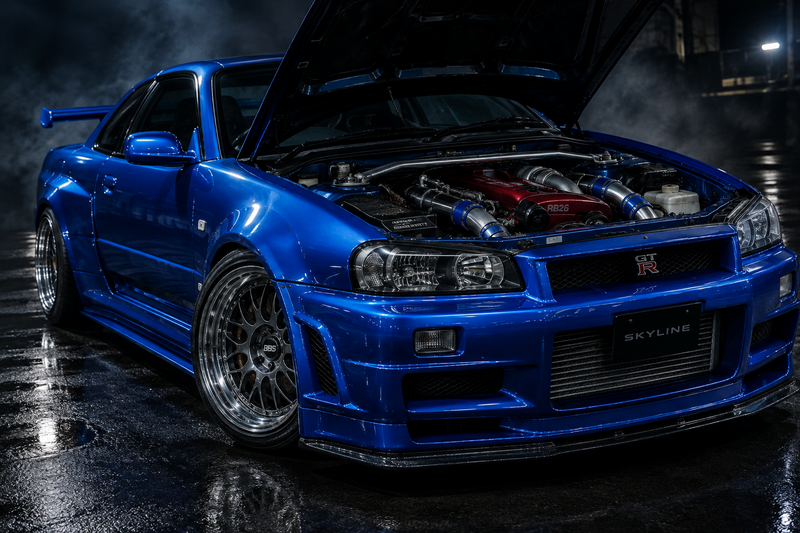
The BNR34 (1999–2002) is the icon. Prices have gone to the moon and they're not coming back. If you're buying an R34, budget accordingly and don't try to find a deal — a cheap R34 is almost always cheap for a reason.
Rust: The Deal Breaker
Rust is your biggest enemy with any Skyline GT-R. These cars are 25-35 years old now, and even well-maintained Japanese examples can have rust lurking in places you can't easily see.
Critical areas to inspect: floor pans (both sides, under the carpet), the rear wheel arches where the inner arch meets the outer panel, around the fuel tank, the spare tyre well, the front subframe mounting points, and the sill sections. On an R32 especially, also check the area behind the front wheels inside the engine bay.
Bring a torch. Get under the car. Tap suspect areas with a screwdriver handle and listen for a hollow sound. Surface rust on underbody coatings is fine and normal. Structural rust in floor pans or subframe mounts is not fixable without significant money and body shop time. Walk away from those cars, no matter how good the rest looks.
Engine Inspection
The RB26DETT is a robust engine but it has specific failure modes to check. Start with a cold start: listen for any tapping or rattling from the top of the engine. Some tappet noise on a cold start is normal and disappears as oil pressure builds. Persistent noise after warm-up suggests worn cam followers or valvetrain wear.
Check the oil cap for mayonnaise (white creamy emulsion) — this suggests head gasket issues or coolant contamination. On a warmed-up engine, check the coolant overflow tank for any oily residue. Pull the dipstick and look at the oil colour — very dark, almost black oil suggests it's been run long without changes.
Look inside the intercooler pipes for oil. A small amount of light oiliness is normal from crank case ventilation. Significant oil pooling suggests turbo seal failure. Check the turbos for shaft play by reaching in and wiggling the compressor wheel — slight movement is normal, significant play means the turbo needs rebuilding or replacement.
Transmission and ATTESA
The factory Getrag gearbox is generally reliable but can crunch going into reverse if the synchros are worn. Test all six forward gears on a test drive. Second and third are the most common gears to show wear. Any grinding or difficulty selecting gears warrants a gearbox inspection.
The ATTESA ET-S AWD system: on a test drive, find a deserted car park and do some spirited acceleration from a stop. You should feel the AWD system working — the front wheels should be pulling when you accelerate hard. If the car feels very tail-heavy under hard acceleration, the ATTESA controller or transfer case may have issues.
On V-Spec cars with ATTESA ET-S Pro, the active rear LSD adds another potential failure point. These are expensive to repair. Check the service history specifically for ATTESA and LSD fluid changes.
Documentation and History
A Japanese car with its shakken (Japanese inspection certificate) history is ideal. This records every inspection the car has undergone in Japan and provides a paper trail. An export certificate from Japan and customs import documentation are essential for US buyers.
For R34s especially, verify the VIN carefully. There are cloned R34 GTs (non-GT-R) being converted to look like GT-Rs. The GT-R has a different VIN prefix (BNR34) from the GT-T or GT. Check the VIN plate in the engine bay, the chassis stamp, and the door jamb sticker all match.
Mileage tampering is uncommon on Japanese domestic market cars but not unheard of on cars that went through auction multiple times. Wear items — steering wheel, seat bolsters, pedal rubber — should roughly correlate with claimed mileage.
The Pre-Purchase Inspection
If you're buying from overseas, hire a reputable inspection company in Japan to physically inspect the car before you commit. JDM Legends, Car From Japan, and several independent inspectors operate legitimate inspection services. It costs a few hundred dollars and it's the best money you'll spend.
If you're buying locally in the US or UK, take the car to a specialist who knows GT-Rs specifically. A generic mechanic will miss GT-R-specific issues. RB26 specialists exist — find one and pay for their time. A proper inspection costs $200-400 and saves you from potentially thousands in hidden repairs.
Import the right one and you'll have one of the greatest driving machines ever made. Rush it and you'll have an expensive headache. Take your time. Do it right.
Share: