Sidebar blog
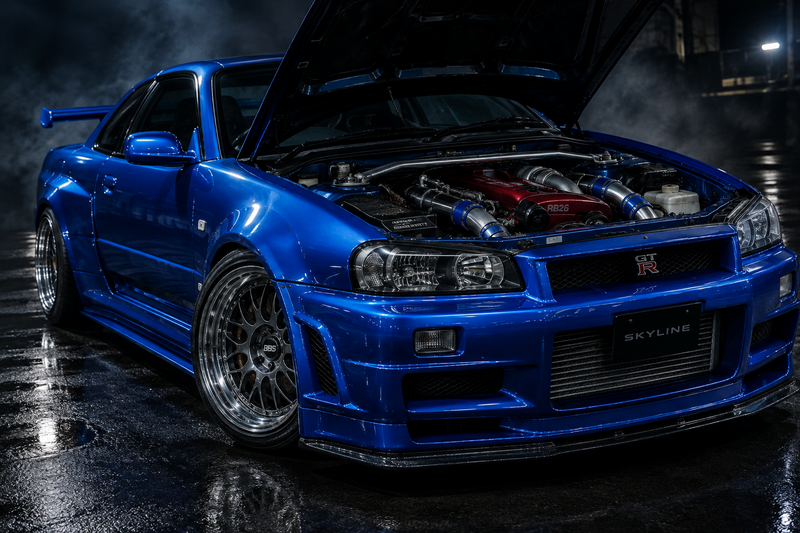
I've spent a lot of time around JDM engines — the 2JZ, the 4G63, the EJ20, the SR20. All legendary. But if you put a gun to my head and made me pick one engine to build a performance car around, I'd pick the RB26DETT every single time. The 2JZ crowd will argue, but hear me out — the RB26 has characteristics that make it genuinely special in ways that go beyond raw power numbers.
The RB26DETT debuted in the BNR32 GT-R in 1989 and continued through the BNR34 until 2002. Thirteen years. In those thirteen years it became the engine that defined an era of JDM performance, inspired a generation of tuners, and proved that a factory engine could form the basis of a thousand-horsepower race car.
What Makes the RB26 Special
Start with the basics: it's a 2.6-litre inline-six with dual overhead camshafts and four valves per cylinder. The block is cast iron — genuinely thick, stout cast iron that handles boost pressure far better than aluminium alternatives. Nissan built this engine knowing it was going to be modified. The factory bore is 86mm with an 73.7mm stroke, giving it a slightly oversquare configuration that loves to rev.
The head is the famous RB26 multivalve design — six individual throttle bodies feeding six cylinders, each with its own fuel injector. The factory airflow meter and plenum sit on top. Stripping the factory intake and fitting individual throttle bodies (ITBs) to an RB26 transforms the throttle response into something almost electric. Some builds keep the stock head; serious race builds replace it with a custom piece featuring larger ports and valves.
The twin ceramic-impeller turbos are one area where the factory setup falls short for modified applications. Ceramic turbine wheels are lighter than steel, which improves spool speed, but they crack under sustained high-boost abuse. Almost every modified RB26 replaces the factory twins with either upgraded ceramic units, steel-wheel alternatives, or single-turbo conversions. HKS GT2530, HKS GT2835, and Garrett GTX units are popular choices depending on power target.
The Block: Why It Handles Abuse So Well
The RB26 cast iron block is genuinely overbuilt for its displacement. Main bearing caps are thick, the cylinder walls have substantial meat around them, and the oil passages are well-designed for high-performance use. As a result, stock RB26 blocks regularly handle 500-600 PS on factory internals when properly supported.
Beyond that, engine builders typically sleeve the cylinders, fit forged pistons (CP, Wiseco, and Nitto are popular brands), add H-beam connecting rods, and use ARP main studs. A properly built RB26 bottom end can support 1000+ PS without breaking a sweat. The record for a single-engine RB26 build is somewhere around 1500 PS — the exact number depends on whose dyno sheet you trust.
Oil system management is important. The factory oil pump is adequate for stock and mild builds. High-power applications benefit from an external oil scavenge system, baffled sump, and remote oil filter setup. The factory setup can starve the engine of oil under high-g cornering if the sump isn't modified.
Cooling System Requirements
The RB26 runs warm. The factory cooling system is adequate for the factory power level in normal conditions, but modified cars generating significant heat need attention paid to cooling. An uprated radiator — aluminium with multiple rows — is almost universal in modified RB26 builds. Oil coolers are standard practice. Some aggressive builds run separate coolant circuits for the head and block.
The intercooler setup matters enormously. The factory front-mount intercooler heat soaks badly under sustained use — it's the main reason factory RB26 power drops off during extended hard driving. An upgraded intercooler with higher-density core material is one of the first modifications most builders do. Larger end tanks improve flow velocity. Water-methanol injection is used in some high-boost applications to manage intake charge temperature.
ECU and Fuelling
The factory ECU handles up to about 330 PS with a remap. Beyond that, standalone ECU management becomes necessary. Haltech, Link, and Motec are the professional choices for serious builds. AEM has a strong following in North America. The ECU choice determines how well you can manage boost pressure, fuelling, ignition timing, and flat-shift/launch control.
Injector sizing scales with power target. Stock 444cc units handle stock power. 550cc injectors are common for 400 PS builds. 1000cc and above for builds pushing past 600 PS at the wheels. Fuel pump upgrades are necessary — most serious builds run dual fuel pumps with braided lines and larger fuel pressure regulators.
The Bottom Line
The RB26DETT is special because it was engineered with purpose. Nissan built it to win races, and they built it strong enough that tuners have been exploiting that strength for 35 years. The architecture is sound, the aftermarket is enormous, and the knowledge base — accumulated by decades of builders and racers — means there are established solutions for every problem.
If you're building a GT-R, you already have the best starting point. Don't overthink it. Learn the engine, understand its requirements, and build it properly. The RB26 will reward you with performance that justifies every bit of the effort.
Share: