Sidebar blog
The 1990s were supposed to be the era of Italian and German dominance in high-performance cars. Ferrari had the F40 and F355. Porsche had the 964 and 993 Turbo. Lamborghini had the Diablo. These were the benchmark cars — the machines that wealthy men bought to feel something.
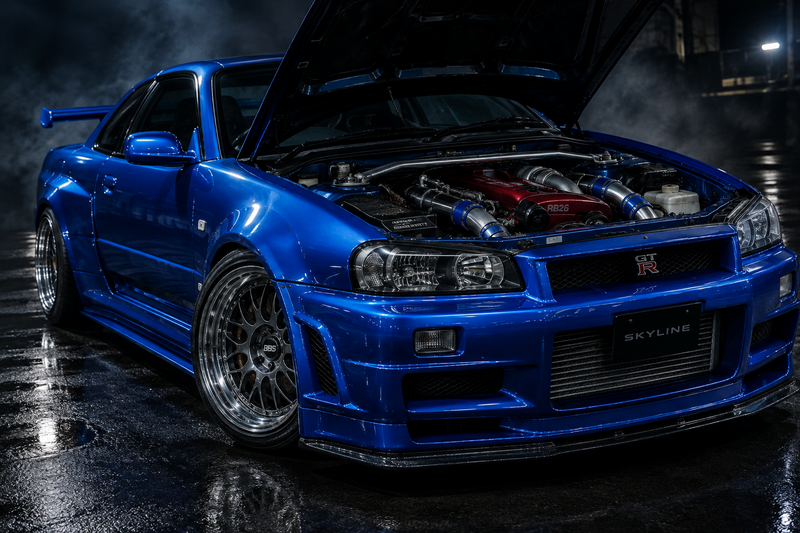
Then a Japanese touring car from Nissan started beating them. All of them. In road tests, on tracks, around the Nürburgring. The GT-R was cheaper than all of them. And it kept winning. This is the story of how a JDM car from a brand better known for family sedans became the supercar killer that changed what performance cars meant.
The Ferrari F40 vs R32 GT-R: Where It Started
The Ferrari F40 was arguably the most celebrated performance car of the late 1980s. Launched in 1987, it made 478 PS and was the fastest production car in the world. It was also over £150,000 even then — an almost incomprehensible sum. It was raw, challenging, demanding. A genuine driver's car.
In 1995, the BCNR33 GT-R went to the Nürburgring Nordschleife for a timed lap. It recorded 8:26. The Ferrari F40 recorded 8:47. A car that cost a fraction of the Ferrari's price was 21 seconds faster around the most demanding race circuit in the world. Not in a magazine test. Not on a perfect day with a professional driver. Documented, verified, faster.
The argument that the GT-R was slow and the Ferrari was special fell apart in a hurry.
Porsche 911 Turbo: The Nemesis
The Porsche 911 Turbo has always been the GT-R's closest rival in terms of concept. Both are rear-biased AWD performance cars with turbocharged engines. Both prioritise all-weather usability without sacrificing performance. Both have loyal fanbases who will argue endlessly about which is better.
The data has generally favoured the GT-R. The R33 GT-R out-accelerated the 993 Turbo in period testing. The R34 GT-R matched or beat the 996 Turbo to 100 km/h while being significantly cheaper. When the R35 launched in 2007, it was directly compared to the 997 Turbo — and won. Motor Trend tested both and found the R35 was 0.3 seconds faster to 100 km/h (2.7 vs 3.0 seconds), 0.6 seconds faster in the quarter mile, and cheaper by a significant margin.
Porsche responded by developing the 991 Turbo S, which fought the R35 to a draw at a higher price. The arms race continues.
The Lamborghini Diablo vs R34
The Lamborghini Diablo is one of the most dramatic-looking cars ever made. It was the schoolboy poster car of the 1990s. The VT version from 1993 made 492 PS and used AWD to manage its power.
In a drag race against an R34 GT-R, the Diablo wins from a rolling start due to its power advantage. From a standing start, the GT-R's superior launch traction made it much more competitive. The GT-R's ATTESA system puts power down better from zero speed than the Diablo's simpler Viscous LSD setup.
On a road course, the R34 GT-R was typically faster than the Diablo due to its superior handling balance and stability. The Diablo was a handful. The GT-R was fast but manageable. Real-world performance nearly always favoured the GT-R when a competent driver was behind the wheel of both.
Why the GT-R Won: The Engineering Argument
The GT-R beats exotics consistently because it was engineered to be fast, not to look fast. Every component — the ATTESA AWD system, the HICAS rear steering, the Brembo brakes, the RB26DETT engine — was chosen to maximise real-world performance. There is no compromise made for image or theatre.
Exotics from Ferrari and Lamborghini in the 1990s were often compromised by their mid-engine layout (great for cornering balance, challenging for traction from standstill), by relatively primitive traction control systems, and by handbuilt assembly that introduced inconsistency. The GT-R was factory-engineered, quality-controlled, and consistent from car to car.
The ATTESA system specifically is the secret weapon. By being rear-wheel drive in normal conditions and AWD under load, the GT-R has the best of both worlds — rear-drive feel with AWD traction when you need it. No Italian car in that era came close to matching this capability.
The Legacy
The GT-R vs exotics debate never really ended — it just evolved. The R35 continues the tradition, regularly embarrassing cars costing three to four times its price. When a GT35R-turboed R35 built for $150,000 runs with $500,000 supercars on track, the GT-R's fundamental mission is being fulfilled.
You don't buy a GT-R to impress people at traffic lights. You buy it because it is genuinely, measurably, verifiably one of the fastest cars ever made for the money. That has been true since 1989. It remains true today.
Share: