Sidebar blog
I'll be straight with you: a Skyline GT-R is not a maintenance-free car. It's a thirty-year-old Japanese performance car with multiple complex systems, and it requires more attention than a modern daily driver. If you go into ownership knowing this and building a proper maintenance schedule, you'll have one of the most rewarding cars you've ever owned. If you ignore it and hope for the best, you'll spend serious money fixing things that could have been prevented.
I've owned GT-Rs and helped maintain others. Here's the honest maintenance picture.
Engine Oil: More Often Than You Think
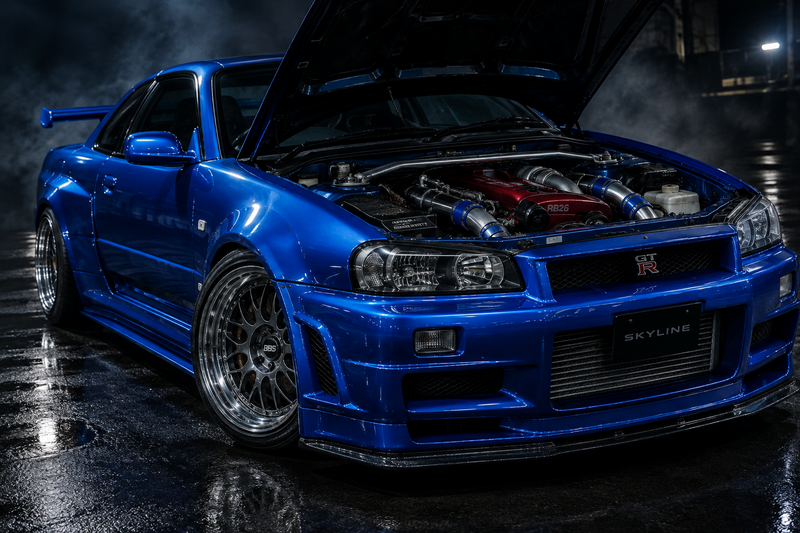
The RB26DETT is a high-strung twin-turbo engine. It runs hot, it works hard, and it circulates oil through two turbochargers as well as the engine itself. The standard service interval in Japan was 5,000 km (about 3,100 miles) for oil changes. That's the right interval for a healthy road car. For any car that sees track time or regular hard driving, 3,000 miles (roughly 5,000 km) is better.
Oil specification matters. The RB26 runs best on 10W-40 or 10W-50 fully synthetic. Motul 300V, Castrol Edge, and Nissan's own GT-R oil are popular choices. The 300V in particular has a following among GT-R tuners for its high-temperature stability. Cheap oil is a false economy on a car with this kind of power output.
Change the oil filter at every oil change. This is non-negotiable. Used oil left in the system through a filter recirculates contaminants. The factory filter position on the RB26 is slightly awkward but accessible with the right removal tool.
Coolant System
The RB26 can run warm, and an overheating RB26 is a very expensive problem. Check coolant level regularly — the overflow tank should be between MIN and MAX when cold. Check the colour of the coolant — it should be clean and bright (typically blue or pink depending on the antifreeze). Brown or rust-coloured coolant indicates corrosion in the system and needs a flush immediately.
Coolant should be changed every two years regardless of mileage. Old coolant loses its anti-corrosion properties and begins attacking aluminium components. The RB26 has an aluminium head, and coolant-related corrosion around head bolt holes is a known failure point on neglected cars.
Check the radiator hoses for cracking, swelling, or hardness. Replace rubber hoses that are more than ten years old as preventive maintenance. Silicone replacements last longer and handle temperature cycles better.
Turbo Maintenance
The factory turbos on the RB26DETT are ceramic-impeller units that are reliable when properly maintained but fragile under abuse. Two rules for turbo longevity: let the car warm up properly before pushing hard, and let the turbos cool down after hard driving.
Warm-up means idling for 2-3 minutes after cold start before driving, then a gentle warm-up period of 5-10 minutes before full throttle. The turbos are oil-cooled and oil-lubricated; driving hard on cold oil shortens their life significantly.
Cool-down means not switching the engine off immediately after hard driving. The turbos continue spinning after the throttle is closed, and if the engine is switched off immediately, oil supply stops while the turbos are still hot. This leads to oil coking in the turbo bearings — a gradual death. Idle for 2-3 minutes after hard use. Or fit a turbo timer if you want it automated.
ATTESA ET-S Fluid
The ATTESA transfer case has its own fluid completely separate from the engine oil and gearbox oil. It needs to be changed every 30,000 miles at minimum — many owners do it every 15,000. Neglected ATTESA fluid becomes dark, loses viscosity, and leads to sluggish torque transfer and premature clutch pack wear.
Signs of ATTESA neglect: the AWD system feels slow to engage, you see the ATTESA warning light, or the car feels predominantly rear-wheel drive even under hard acceleration. Drain and refill with fresh NISSAN MATIC D fluid (or approved equivalent). The drain plug is on the bottom of the transfer case; the fill plug is on the side.
Gearbox and Differential
The Getrag five-speed gearbox uses its own oil (75W-90 GL-4 specification). Change it every 30,000 miles. Worn gearbox oil makes gear selection increasingly notchy, especially into second and third. The rear differential also has its own fluid — same spec and change interval.
V-Spec cars with the active rear LSD have a more complex differential that requires the correct LSD fluid (not standard diff oil). Using the wrong fluid in an active LSD destroys the clutch packs.
Belts, Plugs, and Consumables
Timing belt: replace every 60,000 miles or every 5 years, whichever comes first. An RB26 is an interference engine — if the timing belt fails while running, the engine destroys itself. This is not optional maintenance. Do it on schedule.
Spark plugs: use NGK BKR6E or NGK BKR7E (for higher-power or hotter climate applications). Replace every 20,000 miles or sooner if the car runs modified boost levels. Dirty or fouled plugs on an RB26 cause misfires that feel terrible and can damage the engine over time.
Fuel filter: every 30,000 miles. A restricted fuel filter on a boosted engine leads to fuel starvation at high load — the engine leans out, temperatures rise, and detonation can follow. Fuel filters are cheap. RB26 rebuilds are not.
Look after your GT-R and it'll look after you. Neglect it and it'll take its revenge in the most expensive way possible. The choice, as always, is yours.
Share: