Sidebar blog
In 1973, a man named Hirofumi Hasegawa left his job at Yamaha to start a tuning company with two friends: Goichi Kimura and Hideo Sigma. They took the first letter of each surname — H, K, S — and built a company that would define Japanese performance tuning for the next fifty years. HKS Co. Ltd. is not just a parts manufacturer. It's the institution around which Japan's entire aftermarket performance culture was built.
Walk through any JDM tuning shop, anywhere in the world, and HKS products are there. The SSQV blow-off valve. The GT turbo range. The EVC boost controllers. The Power Editor. The Hi-Power exhaust. These are not just products — they're the vocabulary of JDM tuning, pieces that appear on builds from Tokyo to London to Los Angeles.
The Early Years: Racing First
HKS did not start by making aftermarket parts for street cars. The company entered motorsport almost immediately, developing engine components and exhaust systems for Japanese circuit racing. The racing programme created a feedback loop that defined HKS's entire approach: develop something on a race car, learn what works under genuine competition stress, then make a version of it available to road car owners.
This philosophy is why HKS products are consistently more expensive than generic alternatives and consistently more trusted. An HKS turbocharger isn't designed in a marketing department — it's been tested under race conditions and validated across thousands of track kilometres before it appears in a catalogue.
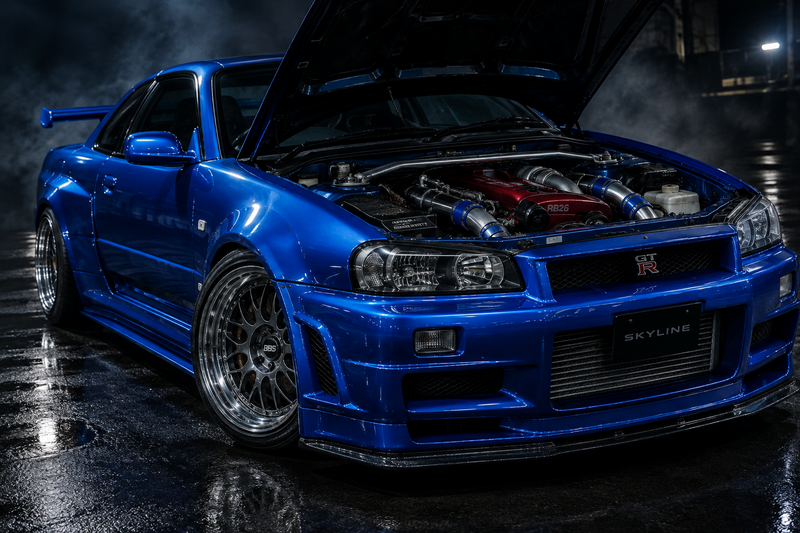
The GT-R was the car that truly established HKS's global reputation. When the BNR32 launched in 1989 with the RB26DETT, HKS was among the first companies to develop serious performance upgrades. The GT-SS and GT-RS turbo kits for the RB26 became legendary. Builders around the world ordered from Japan because there was simply nothing else that matched what HKS was producing for the platform.
The Products That Made History
The HKS SSQV (Sequential Super Q Valve) blow-off valve is probably the most recognisable JDM part in existence. That distinctive 'psshh' sound when a turbocharged car lifts off the throttle? A significant percentage of the time, worldwide, that sound is coming from an SSQV. The valve was designed to vent boost pressure reliably and quickly, protecting turbocharger bearings from the pressure spike that occurs when the throttle closes. Millions have been sold. It remains in production.
The HKS GT turbocharger series covers every significant JDM engine. The GT2530 for the RB26DETT. The GT2835 for higher-power RB26 builds. The GT2871R for SR20DET and EJ20 applications. The GT3582R for the 2JZ-GTE. Each is a genuine ball-bearing turbocharger with a Garrett-sourced compressor wheel and carefully selected turbine wheel — not a generic unit rebadged with an HKS logo.
The EVC (Electronic Valve Controller) boost management system gave Japanese tuners precise boost control through an electronic solenoid valve and ECU interface. Before standalone engine management became affordable and widespread, the EVC was how serious tuners managed boost safely. It's still in production because it still works.
HKS and the 2JZ: Building the Legend
If the RB26 established HKS internationally, the 2JZ-GTE made them essential. When the A80 Supra launched in 1993 with the 2JZ-GTE, HKS threw serious development resources at it. The resulting products — the HKS T51R single-turbo kit, the HKS intercooler kit, the HKS exhaust — became the definitive modification path for the 2JZ platform.
The T51R turbine is genuinely famous in its own right. Built around the Garrett T51R compressor and turbine, it flows enough air to support 700+ PS on a well-built 2JZ. HKS's supporting documentation for the kit — the installation instructions, the recommended supporting modifications, the baseline tune map — demonstrated engineering rigour that generic turbo suppliers couldn't match.
Modern HKS
HKS in 2025 is a different company from the small operation Hasegawa, Kimura, and Sigma started in 1973. The company employs hundreds of engineers and produces products for modern turbocharged vehicles as well as the classic JDM platforms. The HIPERMAX coilover range competes with KW and Bilstein in the premium suspension category. The Super SQV IV (the latest SSQV iteration) includes a new valve design for improved response. The Power Editor series provides plug-and-play ECU modifications for modern vehicles.
But the core philosophy hasn't changed. Race first. Validate under competition. Make it available. Trust the engineering over the marketing. In fifty years, that approach has produced a catalogue of parts that define what JDM performance means. When you fit an HKS component, you're fitting something that has a direct lineage to a race track. That matters. It's why HKS endures while other tuning brands come and go.
Share: