Sidebar blog
In JDM wheel conversations, Rays Volk Racing gets the glory and the premium prices. Work Wheels gets the stance crowd. But in workshops where people are actually building serious track cars on reasonable budgets, you'll find Enkei wheels under a significant percentage of them. The Enkei RPF1 specifically is one of the most technically well-executed wheels in history, and it costs a fraction of what a comparable Volk Racing wheel costs. Understanding why Enkei commands the respect it does means understanding what makes a wheel actually work.
Enkei Corporation was founded in 1950 in Shizuoka, Japan, initially as a die-casting company. The move into aluminium wheels began in the 1970s, and by the 1980s Enkei was supplying OEM wheels to major Japanese manufacturers including Honda, Nissan, Subaru, and Mitsubishi. If you've driven a Japanese car from the past four decades, there's a reasonable chance you've driven on Enkei wheels without knowing it.
The RPF1: Why It Matters
The Enkei RPF1 (Racing Performance Flow-formed 1) is the most technically significant wheel Enkei makes for enthusiast use. 'Flow-formed' describes the manufacturing process: a cast aluminium blank is spun at high speed while rollers shape the barrel, work-hardening the aluminium in the process. The result is a wheel that has much of the strength of a forged unit at a significantly lower price point.
The RPF1 is extraordinarily light. In 15x8 — a classic size for Honda builds — the RPF1 weighs just 5.0kg per wheel. For context, a decent cast aluminium wheel in the same size would weigh 7-8kg. The difference across four wheels is 8-12kg of unsprung rotational mass — a meaningful improvement in handling, acceleration, and braking.
The five-spoke design is structurally efficient and visually clean. It's not trying to look exotic; it's trying to be light and strong. This functional honesty is why the RPF1 has been used in Super Touring, Formula 1 support races, and club motorsport for decades. Racing series that specify Enkei wheels do so because they're trustworthy.
The GTC01 and GTC01RR
The GTC01 is Enkei's answer for enthusiasts who want something more visually dramatic than the RPF1 without sacrificing the engineering quality. The ten-spoke design is more complex, the machining more detailed, and the finish options more varied. It remains a cast-then-flow-formed wheel rather than fully forged, keeping the price accessible.
The GTC01RR (Racing Response) is the track-focused version with additional weight reduction. Enkei removes material from the back of the spokes through careful CNC machining. The visual result is a wheel with deeply undercut spokes that looks more expensive than it is. The performance result is a wheel that's meaningfully lighter than the standard GTC01 with identical structural integrity.
Enkei and Formula 1
A fact that surprises many people: Enkei supplies wheels to Formula 1 teams. The F1 connection is not marketing spin — Enkei produces wheels for multiple teams and has done so for decades. The engineering requirements for F1 wheels — extreme load, high temperatures, precise dimensions, absolute reliability — are more demanding than any road car or club racing application. Enkei meeting these requirements consistently is evidence of genuine engineering capability.
The technology and quality control standards developed for F1 supply feed back into the production wheel range. When Enkei talks about engineering standards, the F1 programme is the proof that those standards are real.
Sizing and Application Guide
For Honda applications (Civic, Integra, S2000): 15x7 or 15x8 in +28 to +45 offset for the RPF1. The S2000 specifically runs 17x7.5 front, 17x9 rear in factory spec; the RPF1 in these sizes sheds significant weight over OEM wheels.
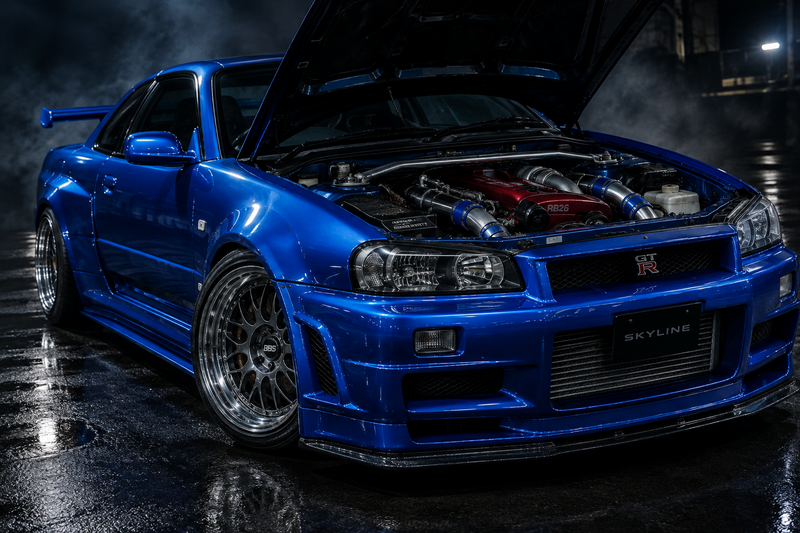
For Nissan applications (Silvia, 180SX, GT-R): the GT-R requires staggered fitment — 18x9.5 front, 18x10.5 rear in typical built-car spec. Enkei's GTC01RR handles this application well. For Silvia and 180SX, 17x9 in +15 to +30 offset for a flush fitment without excessive stretch.
For Toyota applications (AE86, MR2, Supra): the AE86 community has standardised on 14x7 and 15x8 RPF1s for track use. The small diameter keeps rotational inertia minimal, which the AE86's engine appreciates at the top of its rev range.
Enkei wheels are available through authorised distributors including Grovexo. Genuine Enkei wheels carry a serial number and quality mark on the inner barrel. The aftermarket for fake Enkei wheels exists but is less extensive than the fake Volk Racing market — largely because Enkei's reasonable pricing makes counterfeiting economically less attractive. Buy from an authorised source and you'll have no concerns.
Share: